So, I’m finally almost unpacked. The conference was, as always, a sensory overload. Adding to the chaos was that thanks to Airbnb-related shadiness, I had to stay in three different places over four nights. That was fun.
Los Angeles was (and presumably still is) beautiful. I don’t think it’s fair to judge any city by its downtown, but I was impressed by how clean and well-kept it was. On a half-hour walk to the Ace Hotel, I turned to my friend and said, “Look at that. We’ve been walking all this time and haven’t seen a single piece of trash.”
“What about that?” he said.
“That’s a leaf,” I said. And it was. When recounting this anecdote to friends during the conference, they were always quick to point out stray pieces of litter on the street, many of which turned out to be leaves. And some Angelenos explained that this cleanliness comes at a cost: “It’s partly due to the way this city is policed,” my friend Carlos said. The LAPD, it turns out, has the nation’s highest rate of killings by police officers.
While I wasn’t shocked by the number of homeless people (every city has its homeless population, sadly), I was shocked by the callous way a paramedic dispatcher responded when I called about a man who had collapsed on the street. I discussed that incident in another post, which I’ll update later. I don’t want to sidestep social issues, but it’s a much different discussion.
Speaking as a harried convention-goer, the city was a lovely backdrop for all the literary events. During a Pittsburgh winter, you kind of forget that color exists, so this visit perfectly coincided with the coming spring. I didn’t have much time for extracurriculars except for David Bowie party on the rooftop of the Ace Hotel and to visit The Broad, Mignon, and The Last Bookstore. I highly recommend all four. The Broad, in particular, has some of the best Basquiat pieces I’ve ever seen.
Anyway, in case you couldn’t make it to the conference (or want to relive the magic), here are a few highlights from panels I attended:
F107. How to Get Away with Murdering Your Darlings: Revision in the Classroom. (Amy Monticello, Molly Patterson, Phong Nguyen, Jenny Molberg) Writing is revision, but how to teach it? Students leave workshop with ample feedback on drafts, but they’re often baffled when moving forward. From the fine-tuning of a line to the reshaping of a plot, revision is a re-visioning of the project at hand. Proceeding from the belief that the best is yet to come, this panel will offer practical strategies and pedagogical models for guiding students of every level and genre—poetry, fiction, and nonfiction—into and through the process of revision.
Honestly, I was impressed with the panels. In the past, they were a decidedly hit-or-miss affair. But this year, the panelists had interesting, and often hard-won, insights and advice to share. I think the trick is choosing the right panels, but even the Q&As were mostly solid. No one stood up and started a “question” with the phrase “Well, I’m a writer and….” No one asked complicated four-part questions. No one tried to hijack the Q&A and start their own conversation with the panel. Maybe writers have just become better at explaining/modeling the etiquette.
At any rate, one of the most useful things I took away from this panel was related to revision and the nonfiction workshop. I don’t know who’s speaking here (taking notes, recording, and taking photos at the same time is harder than it looks). But the panelists were talking about having students ask questions as a way of dealing with the workshopped students’ instinct to defend him or herself:
Just this semester, I had a student whose father passed away at the beginning of the semester, and her first workshopped piece about five weeks later was about that experience, and so of course everybody in the room who had noticed her absence at the beginning of the term understood immediately the connection between that absence and what was in her first piece. And as the facilitator…I think [another panelist] made a good point about the teacher participating as a fellow writer, also knowing when to guide more than just participating.
And that’s a hard balance in nonfiction, where we’re trying to arrive at human insights. So we’re really talking about a vulnerability that isn’t just about recounting those experiences but making meaning out of them, and so I do also employ the question as a way of pushing on the writer’s thinking and moving away from the experience itself to what the experience means. Because that’s probably the problem that I think I encounter the most with my nonfiction students. They can write a beautiful scene, they can characterize their parents and siblings and friends and people who matter to these essays, but the workshop is so often there (with essays) to figure out what piece of insight the writer has come to share…you always hear that phrase “the workshop is not a therapy room,” but I think that’s bullshit.
Because [students] are grateful to have other people help them sort through the possible meanings and implications of those experiences. We separate a little bit…I don’t allow them to talk about each other as the writer in the room, they still refer to the narrator in the essay as “the narrator.” We try to put that critical distance in to discuss how that narrator has developed an ethos. So that we can have that ability to analyze what they’re doing. But ultimately, we’re there to help them see the potential…
I love how this insight blows apart a long-held belief about workshops (“The workshop is not a therapy room”) while still acknowledging where the sentiment behind that phrase (we’re not sharing these stories simply to make each other feel better).
F190. Monsters Under Your Bed: Writing from Folklore, Reinterpreting Legend. (Millicent Accardi, Jose Faus, Maria Vasquez Boyd, Amy Sayre Baptista, Miguel M. Morales) Literary interpretations of folklore range from cautionary tales to tales of terror. Latino and Portuguese writers examine iconic figures in Latino and Lusophonic cultures like El Cucui, Los Duendes, and La Llorona. Learn why and how these nightmarish figures fit into youth-friendly literature promoting life lessons, how they retain aspects of frightening folklore and culture, and how reinterpretations strive to preserve adult nostalgia for these beloved beasts and sentimental specters.
Every AWP has a panel so crowded that it starts to feel like a U2 concert in a 7-Eleven. This one was also packed with so much information that it’s probably one of those “you had to be there” panels. That said, here’s a quick excerpt from Millicent Borges Accardi’s intro:
Fairy tales are arguably one of the most important cultural and social influences on children’s lives. But until recently, little attention has been paid to the ways in which writers and collectors of tales use traditional forms and genres in order to shape children’s lives–shape their behavior, values, and relationship with society.
There’s a lot to unpack here, but I suppose my first question would be: “But are they?” I’m not saying this to be antagonistic, but if we’re thinking about influence and duration, wouldn’t television (or, for kids with iPads, Youtube videos) be one of the biggest influences on children’s lives?
One could argue that many shows for children include (or repackage) traditional fairy tales, or narratives with similar goals. And since storytelling is such a good vessel for a moral lesson, it’s possible that fairy tales are more influential because they’re told and repeated by parents, who have a lot at stake. For me, the highlight of the panel was Miguel M. Morales’ stories of growing up as part of a migrant worker family. Since there were so many dangers near where they lived (for example, deep drainage pools with steep, slick sides), his parents would invent terrifying creatures to scare him away from them. In that sense, the purpose of fairy tales isn’t just imparting morals: it’s survival, plain and simple.
Also, the idea of being a “collector of tales” is an interesting approach I hadn’t really considered before. But it makes sense, especially the way Zora Neale Huston collected folklore and family stories.
During the Q&A, a man in the audience explained that he was a white Canadian and felt like he was at a disadvantage because he didn’t grow up in a culture dense with such strange stories and creatures. He seemed worried about appropriation. The panel talked about combining different stories from different cultures, and about the universality of some stories (the Cinderella story, for example, is found in most cultures). I think my advice would be: “You might not have grown up with the same Mexican and Portuguese legends, but I bet there are a number of Canadian tall tales or creatures that are maybe so familiar that you’ve overlooked them–or you can easily find with some research.
Also, in one of those “you had to be there” moments, the panelists gave masks to the audience members.
S247. Slouching Tiger, Unsung Dragon: The Next Chapter of Asian American Writing.(Anna Ling Kaye, Ed Lin, Doretta Lau, Chiwan Choi, Paolo Javier) What does it mean to be a writer of Asian descent publishing in North America? These five writers are exploring territory beyond tiger moms and immigrant hardship, venturing into updated expressions of Asian masculinity, Confucianism, and contemporary Asian culture. The panelists will discuss traditional and experimental approaches to Asian American fiction and poetry, and explore how artistic and professional choices impact perceptions of their work and their identities.
I’ll be talking about this panel in a forthcoming article celebrating Asian Pacific American Heritage Month, so for now, I’ll just share the funniest moment from the panel:
Anna Ling Kaye, moderator: “What are you personally interested in seeing in the next chapter of Asian-American writing?”
Chiwan Choi: “Can Asian people have sex with each other onscreen? Like, Master of None, I watched it, and I was like, “Where are the Asian women in this show? [He talks about other television shows, including The Walking Dead.] But is there like a rule?”
Doretta Lau: “I think Asian people are having sex.”
[Choi introduces the phrase “Asian-on-Asian sex.”]
S268. The Long View: Moving from Essay to Book. (Geeta Kothari, Ladette Randolph, Irina Reyn, Marie Myung-Ok Lee, Elizabeth Kadetsky) A narrative inherently changes shape when an author moves from short story to novel, but what about from essay to book-length nonfiction? What gets upset when the word count lengthens, and what might be gained by starting from the kernel of a theme or a structural motif contained in an essay? Might an essay collection gain market power by tackling a larger subject that strikes a chord with a wide readership? Editors and writers discuss their experiences in making books that began as essays.
Five minutes, my ass
For some reason, every year there’s a panel that’s at least 5 miles away from you. Making it there on time is basically like the scene in Home Alone where everyone’s sprinting to the airport. LA being LA really upped the ante: I had to jog from the meeting room level of the convention center, then exit the building. Once outside , I had to jog to the Ritz Carlton hotel for some reason, then take some shady back entrance into the Marriott. Once I’d finished that epic journey, I had to walk up at least two flights of stairs, then down–and then up–another flight of stairs.
It was annoying for me (I was still late), but I can’t imagine what AWP is like for people with disabilities. I am proud to say that my friend and colleague Ellen McGrath Smith is on the conference’s first Disability Caucus. They’re on it, in other words.
Five minutes, my ass
I’m going to quote from Geeta Kothari because I think her ideas can also apply to short stories and novels.
Here are some things I failed to do when writing a book based on one of my essays: no one told me to, I just did it. And [of this process], I’m reminded of the…Alexander Pope quote “Fools rush in where angels fear to tread.” Some things I did not consider when writing the book:
I did not ask myself if my essay had a traditional narrative arc (or any arc).
I did not ask whether it raised a question at the beginning that it answered by the end. Or how, as a series of images (which my essay was), it would work as a longer, book-length project. Would the book copy that lyricism? This is an important question because in order to keep the reader engaged, you need some kind of question at the beginning, and you need a “what next?”
How does the essay handle time? How much time does it cover, and what’s the balance between scene and summary? I think an essay can get away with fairly large chunks of exposition, but in a book-length project, you can’t go on for pages of rumination without giving the reader something concrete to hold onto.
She talked about outlines and said that anyone turning an essay into a book should think about how they’ll outline the book. “You should constantly think about chronology and how things are arranged in relation to each other, where they fall in the timeline.”
She also mentioned that the book required research that hadn’t been done by the time she’d written the essay. [I think she meant that no one had studied or written about her topic before.] “The essay was actually written to accommodate the gaps in knowledge that I had.” While doing research for the book, she came across “new info that drastically altered the nature of the book and its structure. I fought against it, tried to stick to my original vision, but finally had to give in.” Writing is largely about making mistakes, and I appreciated the way Kothari was honest about her “failed book” and used her experience to help keep others from wandering in the same wilderness.
I’ve attended this conference six times (NYC, DC, Chicago, Seattle, and Minneapolis), and a pattern has emerged: I reconnected with some old friends I haven’t seen in years, although there wasn’t enough time to meet up with everyone. I missed out on some great panels, but Claudia Rankine’s keynote was one of the best in years.
Being a writer is a difficult, lonely job. But one thing that’s sustained me through the years is knowing that because I’ve stuck with it, when I walk through the conference bookfair or the hotel bar, I’ll inevitably run into an old friend, a former student, someone I published when I was fiction editor of The Fourth River, or maybe even someone who’s read or published me. People who share the same passions (this means a lot because the world at large does not value books the way we do). If I attend a reading, I’ll probably meet one of my new favorite authors, and they will be just as smart and kind as I’d hoped. It’s easy to forget when you’re on your own or mired in your grading bunker, but I’m glad to work as part of such as supportive community of teachers and artists, and I’m glad we have a conference like this at which to gather, even if it’s only for a week.
And since my old mentor Chuck Kinder told me it was best to end with an image, and because Geeta mentioned them in the last panel I attended at AWP 16, I think it’s best to conclude with some photos. In my head, I’m still arranging them into a more coherent narrative, but the story of AWP–the story of some many writers and collectors of tales together in one place–is bigger than this writer, and certainly bigger than this post.
I have a lot to say about AWP: about how beautiful and colorful Los Angeles was, about how nice it was to catch up with old friends, and how much I got out of the conference. But something happened as I was heading to LAX (and back to my comfortable academic job in Pittsburgh) that I can’t stop thinking about. So I figured I’d share it first.
10:38AM in Los Angeles: [I dial 911 and explain the situation to the dispatcher, who then transfers me to the paramedics.]
Paramedic dispatcher: What’s your emergency and location?
Me: I’m at Ninth and Figueroa. There’s a man lying facedown on the sidewalk. [The man appeared to be in his late 30s. He was dark-skinned, maybe of Southeastern Asian descent. He had shoulder-length black curly hair and was wearing clean cargo pants, a clean t-shirt, and a pair of clean sneakers. Inexplicably, and maybe congruous to his situation, a pair of new-looking brown New Balance sneakers were scattered on the sidewalk a few feet from his head.]
Dispatcher: Is he in front of a specific building? Any specific landmarks?
Me: I’m at Ninth and Figueroa. He’s the guy lying facedown on the sidewalk.
Dispatcher: There are lots of people facedown on the sidewalk there.
Me: Um…not today.
Dispatcher: Did you talk to him?
Me: I asked if he was okay. He looked up at me and mumbled something. I didn’t really understand him. [Notably, he was lying on the sidewalk’s main thoroughfare, not the edges and corners where the city’s homeless sleep. We all had to step around him.]
Dispatcher: Is there any blood? Any visible sign of trauma or injury?
Me: I didn’t see any. He didn’t look very well. He seemed disoriented and out of it. When I was talking to him, he didn’t seem to register it.
Dispatcher: Well, what do exactly you want us to do here?
Me: I don’t know. The man’s clearly not okay. He’s lying facedown on the sidewalk and unresponsive.
Dispatcher: You said he talked to you.
Me: He just mumbled something. He didn’t seem very interested in talking to me.
Dispatcher: What exactly do you want us to do here?
Me: I don’t know. I guess I just figured I’d let you know. If you don’t want to help, I don’t know what to tell you.
I’m thrilled to be a panelist at this symposium, held on Pitt’s campus through the Public and Professional Writing Program. I know Sarah Leavens, who organized the whole thing, and many of the panelists–I know it’s going to be fun, informative, and useful. Hope you can join us!
Details:
“Are you Facebook Frustrated? Twitter-tangled? Stymied by Snapchat? Do you wonder about the professional uses of social media? You’re not alone! The ability to connect with anyone from anywhere, digitally, and the near necessary need to present a digital version of yourself in multiple iterations has changed how we socialize, how we write, and how we define professionalism. Pitt students studying this rapidly-evolving field will present on the most popular platforms and answer your questions about best professional uses, followed by a Q&A from a panel of social media professionals, including two Pitt PPW grads, a social media strategist from ModCloth, and a professional author.”
Littsburgh has some great coverage (including an interview) of this sad news. Thanks to Rachel Ekstrom for reaching out to Sherrie Flick, Kris Collins, and me for our thoughts.
Just in time for Valentine’s Day, here are three things I’ve recently fallen in love with:
1. Kentucky Route Zero. It’s a point-and-click game–it brought back memories of Maniac Mansion, the first videogame I ever played, joystick and all. However, MM‘s control scheme was frustrating and felt outdated even on a Commodore 64; Kentucky Route Zero‘s developers managed to preserve the best parts of the genre without the drawbacks: the result is a game with beautiful and stylish graphics; a gorgeous, immersive soundtrack; and a unique mixture of Americana and dread.
I just finished Act I, but here are a few screenshots that really don’t do it justice:
Also, if it matters, I’m not alone in my love for this game, which is also a unique mixture of weird-but-accessible. I’m bad with directions and hate feeling lost in the world of the game, so most 8-bit adventure games are off the table. I gave up on Year Walk, and even the beautiful worlds in Fez eventually became too tiresome after I couldn’t figure out the world map. But somehow, I felt lost and disoriented in KR0 without ever becoming frustrated. Can’t wait to start Act II.
2. This band and this song.
3. I avoided reading Station Eleven for a long time. I don’t know–I love postapocalyptic stuff, but after a while, I noticed a certain sameness creeping in. Even beyond tiresome character tropes and scenarios, sometimes it felt like writers were using the genre to lazily spew an uninteresting brand of nihilism.
Anyway, at a point when everyone was talking about this book and I was flush with cash, I bought a ticket to hear Emily St. John Mandel give a talk in Pittsburgh. (Also, one of my New Year’s resolutions was to read more contemporary books.)
I was really impressed with Station Eleven: the author was clearly aware of the genre’s conventions and made some smart decisions to make the subject matter feel new and fresh. Also, many of the ideas in the book are genuinely thought-provoking. I can’t wait to hear what she has to say on Monday.
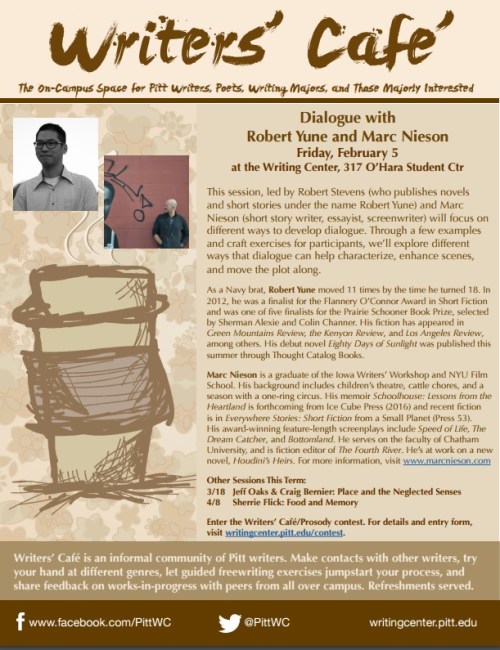
I’m very excited to be co-leading this session on dialogue with my good friend Marc Nieson. I’m still in the late planning stages, but I think I’ll include some examples by Emily St. John Mandel and Amelia Gray. If you’re in Pittsburgh, I hope you can stop on by.
If you teach for long enough, you get to see your students interviewing teachers you had in college. It’s a strange-yet-satisfying feeling, like watching a circuit complete itself.
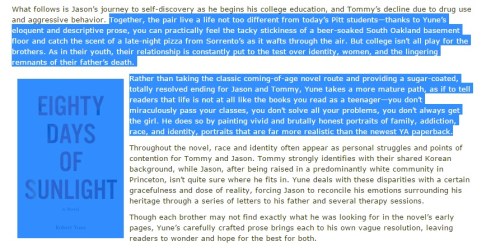
Special thanks to Laura Clark Rohrer (for writing and editing the article) and to Robyn Coggins (for passing along my novel to Laura).
EDOS looks gorgeous in the “bookshelf” section of Pitt’s official alumni magazine, which reaches over 260,000 readers nationally. If that’s not enough reason to pick up a copy, this issue is packed with literary stuff, including an interview with my former grad school classmates Katie Coyle and Rachel Mangini. It also features writing by Pitt alums Micaela Corn, Libby Ferda, Matt Cichowicz, and Breanna Durham.
When I walked out of the theater after seeing Episode I: The Phantom Menace, I finally understood that the universe was a cruel, indifferent wasteland and that existence was largely meaningless. I knew that my heroes would go to dramatic lengths to disappoint me, and that any high points in life were merely buildups to some great cosmic letdown. There was the sneaking suspicion that things I loved hadn’t been that great to begin with–I’d just blinded myself to their flaws.
Not to be dramatic, but as I walked across the parking lot, blinking in the harsh sunlight, I understood that my life from that point on was going to be a slow, steady march to the grave. My childhood officially ended when I saw The Phantom Menace. I was 22.
And now, Disney and J.J. Abrams want me to risk that experience again. “It’s a different approach,” they say. “We’re using practical effects instead of CGI,” they say. I mean, I want to trust them. They’re saying all the right things. But I can’t help but think of Lucy with the football. “No thanks,” is what I want to say. Except…who am I kidding? I know I’ll watch the movie, in the theater, when the lines die down and I’m ready. Aside from the sneaking suspicion that this movie will be another gigantic disappointment, I’m worried that some bozo online is going to ruin it for me. My original plan was to take a break from all social media until I got around to seeing The Force Awakens, but then I found this.
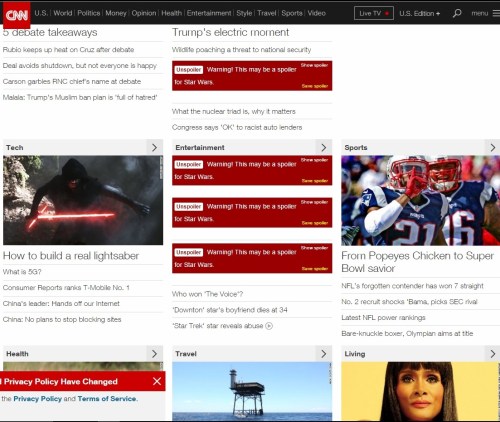
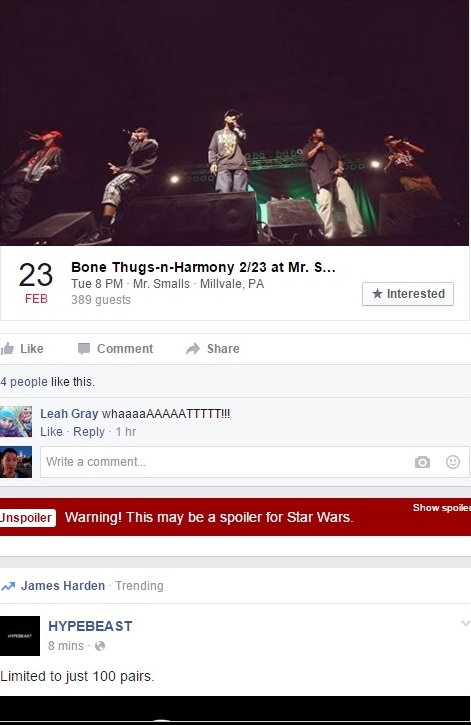
There’s a Chrome extension called Unspoiler that you can tailor to different shows and films (might I recommend The Wire, Seven, and Battlestar Galactica if you haven’t seen them). I plugged in “Star Wars” to the program and it got to work, albeit a bit zealously:
And, as long as you’re viewing them through Chrome, it also works with social media:
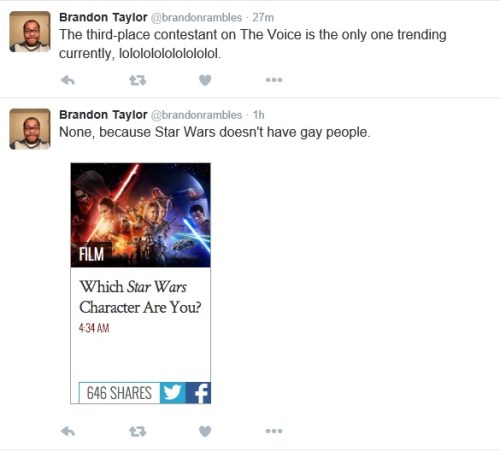
I’m pretty sure that few of these red bars are actually covering spoilers. I was pretty sure Brandon hadn’t seen the movie yet (since it isn’t out yet?), so I clicked on “Show spoiler”:
So, even though Unspoiler seems to be taking the “pray and spray” route, it’s still getting the job done. And I’m okay with missing out on a few tweets and clickbait headlines until I actually get around to seeing the movie.
I’ll check in either way, but if I hate TFA, you won’t hear me caterwauling about it. After being fooled by all three prequels, if I end up on my back, dizzy, the football unkicked, I’ll have no one to blame but myself.





 Robert Yune