I’ve been to several AWP conferences through the years. I’ve even been a panelist once or twice. To be honest, it’s hard to say how exactly the conference has made me a better writer, but I do think it has. Here are some stray thoughts, mostly in the form of advice, as I work my way toward an answer.
Especially if you’re flying in, do whatever you can to not get sick. Even when I’m waiting in line to pick up my badge, I’m going to wear a mask. Being sick at AWP is a unique type of misery I do not wish to repeat. I’m also bringing a gallon of hand sanitizer.
Have a specific goal. When I was in grad school, I wanted to learn as much as possible about craft. More specifically, I wanted to learn more about point of view and regional writing (especially how not to get pigeonholed), so I based the panels and events I attended around that.
It’s very hard to predict the quality or usefulness of any particular panel in advance. It’s good to know that going in.
I do think that networking is the most crucial skill that nobody teaches you, and writers neglect it for various reasons. Learn how to chat with editors and agents without being smarmy or weird. Tag along with your more outgoing (and connected) friends to events. That literary journal you’ve always wanted to get published in? If their editor-in-chief is doing a panel, go to it and maybe chat with them afterward. Get and give business cards, and figure out a way for people to remember you fondly. In the end, being an author means you’re a small business owner who sells books and personality. No one likes to hear that, but it’s true of all artists, including musicians and painters.
To my mind, the worst thing to do is to hang out in your hotel room and party with your MFA classmates as much as possible. The second-worst thing to do is to maximize productivity by attending as many events as possible so that by the end, the whole experience is a fever dream you can barely remember. Personally, between those two extremes, I try to look for unique experiences I can’t get anywhere else.
As with garage sales, during the week, the bookfair booths have a broad selection of stuff for sale. On the last day, they tend to offer steep discounts. No one wants to cart all those books back with them on the plane.
AWP is a good opportunity to practice being a literary citizen, so I try to integrate that into my experience. For example, one of my dear friends is doing a reading offsite, so I’m going to move heaven and earth to attend.
At this point in my career (tenured, 2 books published), I use AWP mostly to catch up with old friends—and to celebrate one of the best parts about my job, which is making so many great friends over the years. I also think it’s a great opportunity to learn more about the host city (including its literary scene and authors). At this point in my life, I’m not attending anything just because it seems like I should, especially if it doesn’t feel useful.
And there’s my answer: looking back, AWP has been mostly beneficial because it’s a way for me to re-connect with the larger writing communuty–to re-immerself myself–and that’s meant more and more to me once I left the thriving literary scene in Pittsburgh. At the same time, I can name specific panels that helped me become a better writer and teacher–and panels whose references helped me overcome impostor syndrome because what I was doing was pretty close to the experts on stage. It’s worth noting that many of the benefits of AWP can be gotten at smaller, local conferences and festivals, too. If you’re in the Mid-Atlantic, the Conversations & Connections Conference is great, as is the Pgh Book Fest.
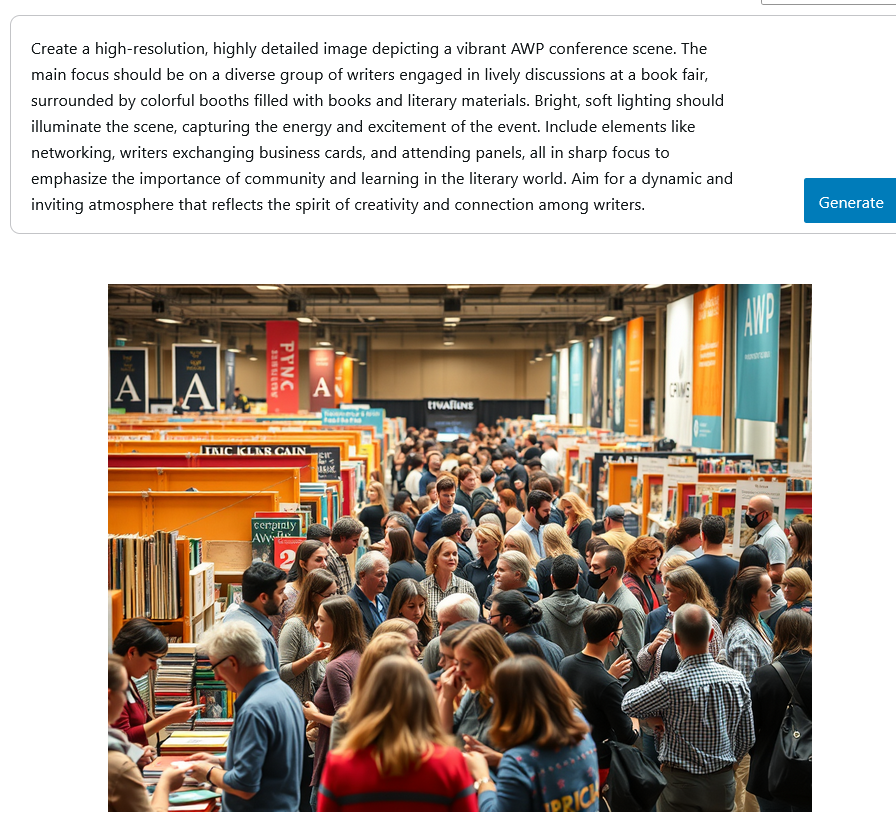
P.S. I’m sharing this grotesque, halfhearted image that WordPress’ AI generated. I guess it generated the prompt based on the text in my post? Anyway, it’s fascinating how the LLM model interpreted “diversity” and “lively discussions.” Despite the unreal nature of this image, anyone who’s attended AWP can immediately recognize the particular vibe it inspires: claustrophobic, fluorescent, corporate-but-make-it-artsy, simultaneously invigorating and exhausting.
 Robert Yune