
I’m very happy to announce that my story “Pockets” has been accepted for publication in issue 12 of The Los Angeles Review.
I’m very happy to announce that my story “Pockets” has been accepted for publication in issue 12 of The Los Angeles Review.

Robert Yune: Can you tell me a little more about the history of Origami Zoo Press? I know it started as a class project, but how did it go from being a project to a full-fledged press?
Rebecca King: Actually, I used to tell myself that I would never get into publishing. I was going to be a writer, plain and simple, but at Chatham, I decided to take the publishing class just to see the other side of the industry, and then I got hooked. I ended up falling in love with the process of making books. I love working with other writers and artists, collaborating with a bunch of creative minds to make something remarkable. After the first chapbook, Phantoms, I knew I wanted to do more.
Full-fledged press? I still feel like a fledgling most days. I will say that becoming a publisher has really allowed me to see what an amazing community the writing and publishing world has to offer. From the beginning, everyone has been so supportive and encouraging. Authors, readers, and even other publishers took the time to congratulate us and read our books. As a writer, you feel alone most of the time even though there are tens of thousands of us. However, as a publisher, I feel like I’m more aware of and even a part of this larger ecosystem. When I decided to continue OZP as a real press after I finished school, I knew I would need help, so I asked Sam Martone to be my associate editor. He and I enjoy similar types of writing, so it’s easy to have a shared vision. Plus, he’s one of the most talented and hardest working writers my age that I know.
Of course, what’s really sustained us is the writing and our readers. From the beginning, I’ve been fortunate enough to work with such talented and generous authors, and really, what is a press without great writing? I just feel honored that these authors trust us with their work. They’re the reason we’re here and writers like them are why we keep going: Chad Simpson, whose book Tell Everyone I Said Hi just won the 2012 John Simmons Short Fiction Award and is coming out soon from the University of Iowa Press; B.J. Hollars, who wrote Thirteen Loops: Race, Violence, and the Last Lynching in America and has edited multiple anthologies including Monsters!: A Collection of Literary Sightings; and finally, Brian Oliu, who wrote So You Know It’s Me and recently released his own anthology Tuscaloosa Runs This.
One thing that strikes me about your chapbooks is how great the covers are. From a design standpoint, what role does the cover and play in the reading experience? Or are aesthetics more important from a marketing perspective (getting someone to pick up and consider the book)?
Thanks! I’m glad you like the covers. After the publishing course, Mike Simms recruited me to do some design work over at Autumn House. It was really a great experience, and I guess that sort of dedication to the appearance of the book stuck with me. From the beginning, I was taught that the design of the book should always be in service of the text. Most of the time, this means the design, especially of the text, should be unnoticeable, almost invisible, so as not to distract from the important part– the text.
I agree with this idea generally, but I also think there are times when design can actually visibly enhance a text. A great example is The Avian Gospels. These books are actually laid out as if gospels, from the little subscript numbers marking every five lines on the white pages with golden edges. These touches bring the book to life and engage the reader on a different level. I think we were going for something similar with Level End. We wanted to play with the notion of video games in the same way Brian’s essays did. We wanted to bring the video game experience to the reader as much as we could. Hence, all of the bonus features, the case, the music, the warning page at the beginning of the book, and the health bars at the top of each chapter.
And we’ve been incredibly lucky to work with such great artists. Greg Leibach did the drawings for BJ Hollars’ book In Defense of Monsters and Nate Pierce did all of the artwork for Level End.
Did OZP authors participate in the design process of their books? In other words, is the chapbook design more of a collaborative effort, or is everything handled by your designers?
We do ask our authors to participate in the whole design experience. As a writer, I understand how precious the book is to the author, and I prefer for our authors to be involved in their manuscript development. Part of what got me into publishing was the collaborative process, and from what I’ve seen so far, collaboration between the different branches–writer, artist, editor, designer, and publisher–really pushes the project to the next level. Of course, as a micropress, all of these roles are filled by a couple people, so it’s easier to balance our opinions.
Aside from anything with “Mario” in the title, what is your favorite NES game?
Believe it or not, I didn’t have an NES growing up. I only played at my cousins’ house, so I was stuck playing their games. Duck Hunt was a favorite, as was Tiny Toon Adventures. I actually grew up playing my dad’s Atari. We played games like Donkey Kong, Pitfall, Space Invaders, and Frogger, at least until the end of elementary school when I got a Gameboy–as big as a brick back then–and, later, the N64.
What’s next for OZP?
I can’t yet say! We do have a couple authors we are working on manuscripts with currently, but I can’t name them at this time. I can tell you that we hope to have a contest at the beginning of next year, and we’re really excited to be opening up to submissions.
A couple years ago, Lorin Stein gave a talk at the University of Pittsburgh. One thing that struck me was how he talked about the importance of the book cover. If you think about it, the phrase “Don’t judge a book by its cover” wasn’t meant to apply to books. Stein said something like, “Oftentimes, the cover is the only thing the customer has to go by, to judge its quality.“
However, I’ll admit that I’ve never thought much about book covers until I started shopping my story collection. I started hearing horror stories from my emerging writer friends. Some of them even told me that the main reason they chose their publisher is because they checked the catalog and “the covers looked nice.” One of them said,”Look, I know it sounds shallow. But you work for years–decades, sometimes–on stories and get paid two copies of the print journal. Then, when the collection gets published, you get paid little and the cover looks awful. It’s like being kicked when you’re down. When you’re a writer, there’s an ever-present sense that no one out there cares. And having a bad cover reinforces that sense of indifference with every copy you see.”
Obviously, writers value many different things in publishing companies. But I’m happy to see that many publishers, especially smaller presses, have invested a lot of time and money in aesthetics. If you look at some contest series websites, you can actually see the covers improving from year to year. As I was looking at different presses, one statement I absolutely loved is from Engine Books:
A book is much more than a container for ideas. As a finished product, it should be an artifact representative of the power in its pages.
And then, there’s this TED talk where Chip Kidd talks about his process in designing a cover. In this post, I wanted to show some love for the graphic designers. Here are a few books from my shelf that I was especially impressed by:
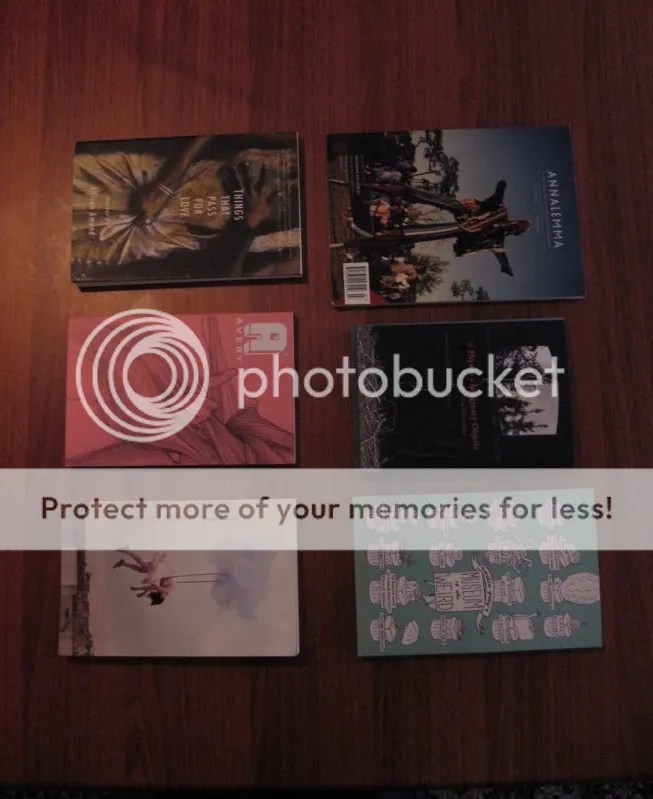
First row, L-R. I know it’s a journal and not a book, but I’ve always loved the energy that the staff at Annalemma, and especially Print Designer Jen O’Malley, put into their journal. Landesberg Design did an incredible job with the jacket of Tina May Hall’s debut collection. FC2 always has great covers, but I especially loved Zach Dodson’s cover for MOTW.
Second row, L-R. When I talked to her about her debut collection’s design, Allison Amend was especially pleased with its “French flaps.” But that cover! It’s by Nancy Racina Landlin, and it’s such a perfect fit for the collection’s subject matter. The last book on the right is by Caketrain Press, whose journal is always a lovely artifact. But the reason I bought it (aside from some prodding by Matt Bell) was the cover photo by Maia Flore. I figured if I didn’t like the book, at least it would look good on my shelf. Fortunately, Matt was right and the stories were as weirdly engaging as he said.
I’m doing this out of order because I’m in the journal, but Avery hired Abi Daniel, an Austin-based artist, to do the artwork for their seventh issue. When I saw the drawing that accompanied my story, I was a little unsettled by how closely it resembled its real-life counterpart. I’d never met Abi before and never really described what my grandparents’ house looked like in the story, but somehow she knew. But the fact that someone was inspired by my story and sat down to create art in conversation with it–that was one moment when it really felt like I’d made it as a writer. I know there are a ton of people I should have mentioned: Henry Sene Yee springs to mind, especially for Steppenwolf. Jay Ryan’s cover for The Final Solution.
I should also mention that solid graphic design costs money, and these publishers should be commended for the time and money they spent to make the books look this great.
At any rate, feel free to make shout-outs in the comments section. Later this week, I’ll post my interview with Rebecca King, founder of Origami Zoo Press, about designing Brian Oliu’s chapbook Level End.
I’m very happy to announce that my story “Liberty and Union” has been accepted at The Golden Triangle. TGT’s featuring some cutting-edge prose and poetry, and their last issue looked like this:

It’s basically the literary journal equivalent of the Palmer House in Chicago. I’m really excited to see what they come up with for issue #2.
It seems like just about everyone I know is finishing up a book-length project, which makes it the perfect topic for a blog post. But writing a book is a long process, so I figured I should probably keep it focused. For some reason, the title of Seth Fried’s book The Great Frustration popped into my head, and I figured frustration would be a great place to start.
So, I asked a few writers, including Seth, to discuss the most frustrating experience they had while writing their books–and how they overcame it. Here’s what my friend and former classmate Aubrey Hirsch said:
The most frustrating part of finishing my book was facing down my own self-doubt. After years of honing my ear and voice and painstakingly training my “inner editor” to notice when something in a story isn’t working, my inner editor started to go a little bit crazy. I finally felt like I had a complete short story collection, and suddenly nothing was right. My metaphors seemed overworked, my characters felt flat and my voice was just so…me. Luckily, a number of my artist friends had experienced similar crises of faith and they encouraged me take some deep breaths, trust in the skills I’d developed as a writer over the years, and tell my inner editor to shut the fuck up. It also helped to show the manuscript to some trusted friends and colleagues. Hearing their responses helped me look at the book with a fresh point of view and gave me the courage I needed to say “It’s done”!
One of my colleagues, Heather McNaugher, has a long-awaited poetry collection coming out soon. I’ve always been curious about the process of putting together a poetry collection. Regarding frustration, she said:
I have published a chapbook of poems, and in April my full-length book of poetry will be published by Main Street Rag Publishing Co. As far as completing and compiling a manuscript goes, in both cases I was my own worst enemy. You see, I refused to ask for help. I wrote in an attic, literally and metaphorically—in total isolation. This is not unusual for poets, but this romanticized version of the chain-smoking loner scribbling profound thoughts means death. Or, in my case, years of wasted postage and time. Take this last instance, with my forthcoming book, System of Hideouts.
At last after three years of writing and rewriting, I had 50 pages of poetry I knew to be stellar. I was especially attached to one poem, the one I read at every reading, the one I thought introduced readers to me in an alarming, authentic way. Now, in class after class, year after year, I tell students that if they are especially attached to a particular line or stanza or poem, it invariably needs to be mercilessly revised, if not cut altogether. How do I know this? From painful experience. I was a student myself once. But in the case of this poem, did I apply my tenet? No. Of course not. I made it the first poem of the manuscript, the poem that shook hands with no fewer than 25 editors of first book contests all over America (25 x 25 bucks a pop = $625.00).
I also insisted on titling the manuscript after a poem, a different poem, that people seem to like when I read at readings. A less interesting title by far, but I was, again, peculiarly convinced that it was the one.
A mentor of mine, Sheryl St. Germain, had offered for years to help me, and at last, literally three days before she boarded a plane for a semester-long sabbatical in France, I sheepishly placed the dejected beast under her door.
Sheryl made two recommendations: change the manuscript title, and swap the first poem for something less, uh, ferocious. The title, she explained, did not do justice to the overall arc of the book; and the first poem yanked us into pessimism, which undercut the project’s more engaging, hopeful message. That’s it. Literally two changes. Here I’d been so terrified, and so overwhelmed, by the prospect of feedback and its ensuing labor, that my solution was, RETREAT! Within three weeks of sending out the new version, I had a call that I was a finalist in MSR’s Editor’s Select Poetry Book Series, with the option to publish. Three weeks! It also ended up a finalist in two other contests.
Has she learned her lesson? Only the next project will tell.
And last but not least, Seth Fried had this to say:
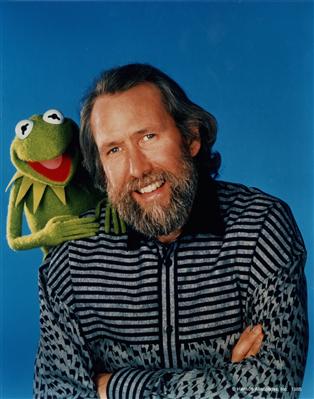
As a fiction writer, my interest has always been in short stories. So perhaps the most frustrating aspect of putting my first book together was the fact that publishers tend to be resistant to the idea of publishing short story collections. As my book was coming together, I spent a lot of time bemoaning the station of the short story. I was like a caricature of a disgruntled artist. I was impossibly bitter over the success of novels that I felt were mediocre when I saw so many talented short story writers (though I was thinking mostly about myself because I’m fairly self-important) struggle to get any traction whatsoever. What snapped me out of it was that one day I started to think about Jim Henson, who has always been a hero of mine… He created some of the most beloved and iconic art of the last century, and I doubt he accomplished that by sitting around and whining about how nobody likes puppets. He saw a medium that made sense to him and waded out into it with joy and enthusiasm and what seemed like an unflappable sense of self. The artists I love and admire are people who never depend on the norms of mainstream culture to determine how they are going to embrace their will to create. This realization has helped me to accept where short stories are at in our culture without any sense of resignation. In fact, I now feel compelled to be more urgent, joyful, and guileless in my efforts to make the kind of art that I want to make.
Special thanks to all the writers. I was really happy that Seth got back to me–otherwise, this blog post title wouldn’t have made much sense. (But I would have used it anyway.) Kind of like if John Malkovich hadn’t starred in Being John Malkovich. If you have frustrating experiences you’d like to share (preferably pertaining to writing), feel free to do so in the comments section below.
Aubrey Hirsch is the author of Why We Never Talk About Sugar (Big Wonderful Press, 2012). Her stories, essays and poems have appeared in literary journals both in print and online, including American Short Fiction, Third Coast, Hobart, PANK, and others.
Heather McNaugher is the author of System of Hideouts (Main Street Rag, 2012). She teaches poetry, nonfiction, and literature at Chatham University, and is poetry editor of The Fourth River. Her work has appeared in 5 A.M., The Bellevue Literary Review, New Ohio Review, Leveler, The Cortland Review, and on the radio show, Prosody. Her chapbook Panic & Joy was published by Finishing Line Press in 2008. She’s tried living elsewhere, but keeps coming back to Pittsburgh.
Seth Fried is the author of The Great Frustration (Soft Skull Press, 2011). His short stories have appeared in numerous publications, including Tin House, One Story, McSweeney’s Quarterly Concern, The Kenyon Review, The Missouri Review, and Vice, and have been anthologized in The Better of McSweeney’s, Volume 2 and The Pushcart Prize XXXV: The Best of the Small Presses.
Jim Henson photo from the University of Maryland.

So, I’m a little late on this one, sidetracked by the end of last semester, but I’m proud to announce that my story “Whiskey” is live at Bluestem Magazine. Special thanks to Roxane Gay for publishing it!
The new issue of The Fourth River’s online component is live. Our featured selection is Geeta Kothari’s story “Wish You Were Here.” When I was selecting fiction for our website, I noticed a musical theme developing and went with it. It just felt right. But aside from how she uses music in the story, I was struck by the story’s transitions, how she develops an evocative sense of ambiguity in the story’s seemingly empty spaces.
This issue’s map image is courtesy the David Rumsey Map Collection and Blog. I picked it because it seems to mimic the activity and sweat of our featured story. But, according to Rumsey’s website, the map, a work of art in of itself, shows the “Coal Field of the Great Kanawha Valley of West Virginia.” It was drafted by John S. Swann in, an attorney, and published in 1867 by Colton & Co. You can see the entire map here. If you look hard enough, you can see Pittsburgh.
And finally, an announcement in case you’re in Pittsburgh tomorrow: R. Dwayne Betts is giving a free public reading and book signing at Chatham University. From the press conference, the date is Friday, Dec. 2. The reading will be at 8 PM at the Welker Room of James Laughlin Music Hall. Betts will read from his memoir A Question of Freedom: A Memoir of Learning, Survival, and Coming of Age in Prison (Penguin/Avery, 2009), for which he won the 2010 NAACP Image Award for Outstanding Literary Debut. In addition, he will read from his collection of poems Shahid Reads His Own Palm (Alice James Books, 2010), which won the publisher’s Beatrice Hawley Award. Betts’ work has appeared in Ploughshares, Crab Orchard Review, and the Washington Post. More information can be found here.

Weave Magazine, founded by the talented poet Laura Davis, is looking for Interns and Editorial Assistants in the San Francisco Bay area. They’re also looking for a SF-Bay Events Organizer. Details can be found here.
I’m happy to say that Weave was founded to help promote diversity in the literary arts. It was founded by a Chatham alum, which makes it dear to my heart, and it was funded by The Sprout Fund, which “supports innovative ideas that are catalyzing change in Pittsburgh–making our community a better place to live, work, play, and raise a family.”
Today is Friday. This is my fantasy football season in a nutshell.

As the holiday season approaches, I’d like to share this timeless advice from Annie Dillard’s “Notes For Young Writers”:
Buy hardback fiction and poetry. Request hardback fiction and poetry as gifts from everyone you know. Give hardback fiction and poetry as gifts to everyone. No shirt or sweater ever changed a life. Never complain about publishing if you don’t buy hardcover fiction and poetry regularly.
Buy books from independent booksellers, not chain stores. For complicated reasons, chain stores are helping stamp out literary publishing.
I’d also suggest magazine subscriptions–and literary journal subscriptions–as gifts. It’s lovely to open one’s mailbox and find a magazine or journal, a nice surprise when one picks up the mail at the end of the workday.

